Home » Uncategorized (Page 3)
Category Archives: Uncategorized

Moonlighting: Reflections on 2016 Baseball Analysis
I offer here a list of links to my 2016 Baseball articles. Some were pretty solid. Others, not as solid as I’d like (apologies to Baltimore and Toronto, whom I underestimated).
The columns received differing levels of play in several different venues. The Studs and Duds columns did quite well. My early season analysis of player rankings and dollar values also score a lot of hits.
This really is a great deal of fun and gives me the opportunity to dedicate some time to the analysis of a sport I love. Many thanks to my colleagues at Major League Fantasy Sports for the chance to trade notes and work with them. Check out the site. It’s a great source of commentary, snarkiness, humor and fine analysis of all sports. Some of the writers are superior analysts of really granular data and trends. My stuff moves back and forth between macro level analysis of players and the league as a whole (see the historical trend pieces) and more granular analysis of pitching. Heck, they even let me put on my professor’s hat and edit. Nothing worse that good sports analysis marred by a split infinitive, gerund without a possessive or dangling modifier…
Anyway, it’s awesome to be able to do this. Baseball is a fantastic sport that appeals to the romantic as well as the geek. If you want to understand Americans, strip away politics and other stuff and talk sports. Even folks who can’t stand one another will be upset if they know that even a sworn enemy is eating turkey and watching football alone on Thanksgiving… Sports get us through long winters and hot summers. Noah Syndergaard said it poignantly in an epic tweet after the Mets lost to the Giants:
Baseball has a way of ripping your  out, stabbing it, putting it back in your chest, then healing itself just in time for Spring Training.
Now then…
“September Studs and Duds”–a reflection on who paid dividends and who killed our rosters
“Strategic Stat Categories and Late Season Moves“–An historical analysis of trends in key counting stats–Saves, Quality Starts, etc.
“Go Big or Go Home: A Rumination of Midsummer Baseball Trends”–a little ancient Greek navigation, some stellar metaphors, and baseball…
Fourth of July, All-Star Break Analysis
Early Season Studs and Duds Analysis, Part II
Early Season Studs and Duds Analysis, Part I
The 25% Solution–Analysis of the first quarter of the Season
Mid-May Musings on Pitching Prowess and Proficiency–An alliterative analysis of Pitching stats. More than any other aspect of the game, pitching stats tell you an incredible amount about pitchers. Other stats are harder to parse.
Lucky Charms and (un?)Lucky Pitchers–oh…just a little anger-inspired analysis of a pitcher who was killing me. I included several other early season duds to provide cover and credibility. I hope Chris Archer was not upset…
Statistical Analysis of Pitching–rant early and rant often. Seriously. Why wait till July to complain about fantasy baseball. Early-season rants will enable you to refine your venomous words so that the pro players get REALLY upset at you later…
“Ailing Aces“–A pretty insightful analysis of what was going on with three stud pitchers who were underperforming.
Week 3 Analysis of the American League East–Wow. Someone must have misread my c.v. They handed this analysis over to a Red Sox fan.
Week 1 Statistically Unsound Assessment of the AL and NL East–OK. You want analysis with virtually no useful data? I can do that…
2016 AL and NL East Predictions–Spring Training is over, the season is not under way. So, predict… Actually, not half bad. Apologies to Toronto and Baltimore. Well, not really…
Preseason Analysis of the San Diego Padres. Waiting for Todd Gurley…
Preseason Analysis of the Philadelphia Phillies. Not so sunny in Philadelphia. Waiting for a year or two. Lots of good baby pitchers here.
Preseason Analysis of the Pittsburgh Pirates. When Fantasy is better than Reality…
Preseason Analysis of the Baltimore Orioles. Wow. They did better than I anticipated. Where did that pitching come from?
Preseason Analysis of the Boston Red Sox. OK. I may have been a homer…but I was right on this one–David Price’s underwhelming performance notwithstanding. Ojala que las estrellas nos bendiguen..
Preseason Analysis of Starting Pitchers–Part n. OK. SO, they wanted me to come up with a tag line. Jettisoned (along with the platinum blonde soul patch) later…
Preseason Starting Pitching Analysis–some pretty decent wisdom and preseason here.
Celebrating the Super Bowl and the Last Days of the Hot Stove League. Column #1
Midseason MLB analysis: Major League Fantasy Sports
My latest analysis is here at majorleaguefantasysports.
Pretty amazing data in the MLB this year. Batting and pitching are both strong. The nuances of data are part of the beauty of baseball.
Why are we celebrating the world’s largest underwater restaurant?
In this story, RealClearPolitics describes the opening of the world’s largest underwater restaurant in the Maldives. Sure, it’s a cool concept. But…

RealClearPolitics 6 July 2016
The Maldives are beautiful, sunwashed islands. But, soon they will be under water. In fact, the same folks who bring us underwater restaurants held several government meetings under water in 2009 in an attempt to make the world aware of their impending doom.
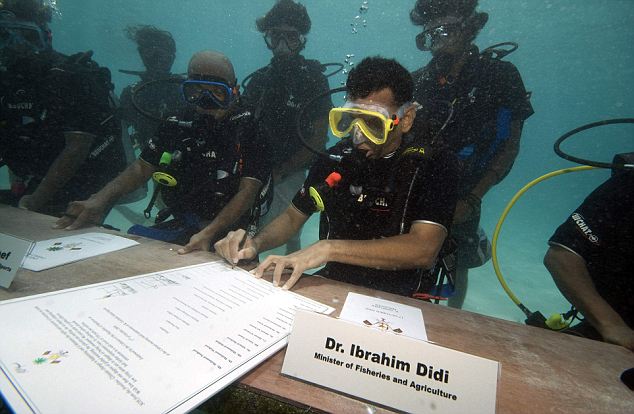

Folks like the ocean…except when it moves in and takes over. When they finish eating and communing with fish, they want to go home to dry land unless, of course, you are megalomaniacal James Bond villain Karl Stromberg who’s decided that, on balance, humanity’s way past its shelf life and needs an upgrade. Ultron had the same idea. But he intended to achieve the same ends by dropping a city on the planet.
Whereas Ulron and Stromberg wanted to extinguish humanity, rising seas will not–at least, not as quickly. Instead, they will create a new class of truly stateless migrants.
Amazingly, on the same day that RealClearPolitics published its piece on Poseidon’s new hangout in the Maldives, The New York Times ran a piece that suggested an alternative reaction to rising seas. In the Chesapeake Bay, residents of Tangier Island are not preoccupied with hiring underwater chefs and wait-staff. Instead, as this article in the New York Times Magazine discusses, the issue is whether the federal government should save the island from being inundated.

New York Times Magazine 6 July 2016
Readers should shudder at both stories. What looms is a crisis of unimaginable proportions. Where will these refugees go? When should they go? Who should receive them?
Hollywood generates all sorts of fantastic world ending scenarios. In a universe expanding so quickly that it alters the speed of light waves, films such as Battleship and both Independence Days suggest that aliens from across this vast, expanding space have nothing better to do but to come and take over the earth. Heck, this was Loki’s plan in The Avengers. Seems that the universe offers very little prime real estate.
Sadly, the joke will be on all these hypothetical invaders because, after they take over, they will discover that a nontrivial amount of that real estate will be underwater. Seems their interdimensional probes missed this.
Seriously: aliens are unlikely to invade. But the seas will rise and we will have environmental refugees. Is the world (and its laws) prepared to address this situation effectively?
Mid-Season Baseball Analysis 2016
In lieu of commenting on an ever-depressing political landscape, I’ve dedicated a lot of energy to baseball analysis for Majorleaguefantasysports. This is a great site operated by a great group of folks who are dedicated to sports and analysis.
My latest couple of columns embody some macro-level analysis of the first half of 2016 for both pitchers and batters. One of the intriguing aspect of baseball analysis and, in particular, its translation into fantasy analysis, is the connection between players’ performance in real life and their valuation in the fantasy markets. This parallels any analysis of stock prices or values at an auction: how do we take a complex portfolio of attractive and not-so-attractive assets and assign a particular dollar value or ranking (relative value) to it?
In this column, I address this with regard to batters. I followup in this column with a similar analysis of pitchers. Finally, in this column, I offer a reflection on the fickleness the relationship between value and performance.
More to come, of course. We are only halfway through the season.
Moonlighting: My latest baseball columns
It’s great to be writing on baseball again. The crisp spring air…the crack of the bat.
I’m now writing for majorleaguefantasysports.com. I’ve started the season doing analysis of Starting Pitchers. the first two columns are located here.
Comments welcome.
If you want to Understand NH and Iowa, Look to Europe
If you want to understand what’s going on in American politics, look around the world. Whether we Americans like it or not, American exceptionalism is and always has been a myth. The country is subject to the same forces that shape the world. It is just that, throughout out our history, geography, economics and wealth have protected us.
No more. Technology has overcome geography. Financial crises that begin in Thailand end up destroying our real estate markets. The Occupy Wall Street movement and the occupation of public lands in Oregon are echoes of the Arab Spring. The nation is wealthy, but not as wealthy as it was when, in the mid-20th century, much of the nonwestern world lived in relatively desperate conditions. Now, the wealth in Asia and the Middle East rivals that in the west.
Global politics has changed. The wave of change that began with the fall of the Berlin wall now manifests itself around the world as the far right and the far left challenge politics as usual.
We saw this in the Spanish election of 2015. For decades, Spain was the poster child of democratic transitions. It seemed to prove that a nation could escape the oppression of a Francoist right wing dictatorship and transform into a modern, liberal polity. Of course, it helped that Spain was located on the western frontier of the European Union. Spain wanted access to Europe’s markets and vice versa.
It is easy to transform peacefully amidst wealth.
But, 40 years after Franco’s death, Spain experienced an electoral earthquake. New, populist parties on the right and the left arose and destroyed the center-right Popular Party and the Center-Left Socialists. Podemos (“we can”) challenged the Socialists’ antiquated notions of European welfare and the Citizens’ Party expressed impatience with the Center-Right’s inability to challenge the increasingly antiquated Socialists. So, the young rose up on the right and the left and challenged the comfortable centrist status quo that their political parents and grandparents had created.
In the United States, we feel the repercussions of this same impatience with politics as usual. Trump is succeeding because his many GOP rivals will not yield in favor of a stronger, party organization that has lacked a coherent ideology since Ronald Reagan challenged the Soviet Union. The GOP rivals are playing a dangerous game of chicken in which, it is clear, no one is likely to swerve. The most likely result will be a brokered convention.
Meanwhile, Bernie Sanders embodies the anger of the Occupy Movement and the youth who have no loyalty to the Democratic Party status quo. Sanders’ undoing will be that he must challenge the Clinton political machine. Whereas Trump can play a cautious game in which he seeks only to ensure a brokered political convention (a virtual certainty as long as he has double-digit rivals), Bernie must look to defeat Hillary Clinton one-on-one. That is unlikely to happen so long as she has Bill Clinton campaigning for her.
What will come of this election? It will not be the revolution that Bernie Sanders seeks. But, we can expect that the GOP will seize this opportunity to reform its nomination process and the political party structure. Presidential candidates must endure a lengthy, expensive nomination process that was designed in response to Richard Nixon’s campaigns. Reacting to his reliance on great sums of money and insider politics, the Democrats opened up their presidential primaries to let the people chose their nominee. The process as designed to ensure that virtually anyone could run for president and win.
As we see in 2016, anyone can and does run. “Anyone” was supposed to be a peanut farmer from Georgia who is able to challenge the political party establishment by taking principled stands and running as an outsider. As we see in 2016 (and saw in 2012), “Anyone” includes the wealthy as well as the commoners. The result is a GOP that has not had a coherent, central ideology (try to triangulate Sarah Palin, John McCain, Mitt Romney, and Donald Trump) and a Democratic Party that is torn between a weakened, wishy-washy middle and an angry populist left wing.
The reforms of the 1970s have begotten unbeatable, gerrymandered incumbents, skyrocketing election costs, political parties with no ideological core, and presidential candidates who struggle to govern alongside an entrenched Congress. Bernie Sanders and Donald Trump may not be the ideal presidential candidates for their parties or the United States. But, they manifest the deep-seeded discontent that the people have for their political system. Sanders may not win. The best Trump can hope for is to force a brokered convention at which he will not win.
The result will be a move towards stronger, more ideologically coherent political parties that guard their nominations from pillaging by outsiders such as Trump and Palin. We will not return to the smoke-filled rooms of yore. But, not just anyone will be able to hijack the nomination process and leave the people with a choice among candidates that really represent neither political party.
The 2016 election will go down in history as a watershed election that brought the political revolutions from across the globe into U.S. Politics. It’s impact will be felt far into the 21st century.
#AACU16 Thoughts and Reflections
Great insights on the annual meeting of the American Association of Colleges and Universities from Bryan Alexander here.
Bryan nicely documents the various threads/themes running through the conference. It is always an intriguing mixture of discussions concerning:
challenges to the liberal model of higher education
the democratizing role of technology in education (and the perceived threat it poses to the liberal model)
study abroad
new/innovative pedagogy
As always, Bryan offers some great food for thought. More to come in response to his posting. For now, I’m happy to publicize his thoughts.
Goldman Sachs and Higher Education’s democratic dilemma
I wrote a comment on the report and the ongoing debate about cost/value in higher education on our other site, Liberal Ed Crisis. The post is here.
The real issue at stake is not necessarily the cost of higher education. If we want to maintain the residential model of higher education, costs will rise as maintaining the physical plant and keeping the student-faculty ratio as low as possible remain expensive.
What is especially troubling is that apologists for the cost of the American model of higher education equate liberal education with a model of teaching that is expensive. They rebel against the notion that liberal education can be conveyed effectively through MOOCs, blended learning or other online educational models. So, as costs increase, critics suggest that the well-to-do will get a “brick-based” education while the 99% will get more of a “click-based” education.
If we continue to resist technological advancement, we then doom the 99% to what seems to be an inferior educational model that will not convey the benefits of liberal learning because it does not entail classrooms, residential campuses, etc. The traditional, increasingly expensive model of education remains an ideal. But, it is clear that if educators do believe that liberal education does convey a package of learning skills and democratic, civic values that are vital to the health of a society, then they have a responsibility to find a way to convey those values through more advanced technological means. If they do not, they undermine the symbiotic connection between liberal education and liberal democracy that organizations such as the AACU celebrate.
If we look beyond the confines of American higher education, we see that technology is driving the democratization of access to education. This TED Talk by Daphne Koller is an especially powerful statement to this effect. It would indeed be paradoxical if, in the name of preserving the means of conveying liberal democratic values, liberal educators made those values less democratically accessible.
The challenge for our educators today is to find a way to put liberal learning to work embrace technology so that we can ensure that access to education, knowledge liberal learning and democratic values is democratized.
Challenges to the West from the Rest–Ross Douthat
Here is a post from our other blog on the crisis in liberal education. It responds to a great piece by Ross Douthat in the 26 December NYT.
We need more judicial activism
I published this piece–In Praise of Judicial Activism–in the Richmond Times here. It received limited feedback. But, it also represents a great change in my opinion. Earlier in my career, I believed that courts should defer to the elected branches and let them take their time to deliberate. Alas, the vision of democracy that underpins that vision is somewhat quixotic. Democracy is quite bogged down by lilliputian interests as Jonathan Rauch and Mancur Olsen have demonstrated. If we wait for vested or entrenched interests to deliberate, minorities may suffer. Besides, if courts really outrage the majority, it still has the power to pass laws in response to court decisions.
 Mark Rush